Through the Nigeria Sugar Institute, Council prepares a new generation of agricultural professionals for the technical demands of Nigeria’s sugar industry
There is a point in every agricultural development story where policy, investment and infrastructure must give way to people.
A sugar estate may have vast stretches of arable land, irrigation infrastructure, tractors and implements, modern production systems and a factory waiting at the end of the production chain. But none of these can deliver their full potential without people who understand the crop, know the soil, can read the field, operate equipment safely, manage water, identify problems early and make sound technical decisions.
This is the challenge at the heart of Nigeria’s long-standing quest for self-sufficiency in sugar production.
For years, discussions about Nigeria’s sugar industry have centred on land, investment, infrastructure, financing, technology and production targets. These remain critical. But beneath all of them is another requirement that is sometimes less visible: the development of a skilled workforce capable of operating a modern sugar industry.
It was against this background that the National Sugar Development Council (NSDC), through the Nigeria Sugar Institute (NSI), took its training intervention to the field at Lafiagi Sugar Company (LASUCO), a subsidiary of BUA Foods Plc in Kwara State.
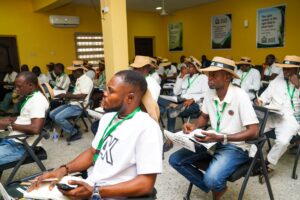
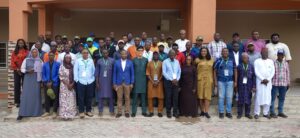
Fifteen young agricultural professionals recruited by LASUCO underwent an intensive technical programme designed to take them beyond the classroom and into the realities of commercial sugarcane production.
The intervention formed part of the Graduate Agricultural Talent Training Program (GATTP), with the sugar-focused training component structured as an 18-day programme. The first 12 days were conducted at the LASUCO estate in Lafiagi, while the final six days took place at the NSI laboratories in Ilorin.
The assignment was clear: turn academic knowledge into practical competence. And that distinction was at the heart of the programme.
Building the people behind the production
The 15 trainees, drawn from Agriculture, Agronomy, Crop Production, Soil Science, and Agricultural Economics and Extension, were young graduates with between zero and two years of experience. Their participation formed part of a six-month BUA Foods graduate development programme.
At Lafiagi, the training was structured around the realities of a commercial sugar estate.
The opening phase introduced the trainees to sugarcane agronomy, climate, soil and water, machinery and land development, irrigation design and scheduling, varieties, seed cane and planting. The programme then progressed into weed and nutrient management, harvesting, drainage, infrastructure maintenance, ratoon management, pests and diseases, field practicals, farm safety, records, economics and quality control.
For Engr. Labaran Sa’idu Audu, Plan Director, LASUCO, the intervention represented an important development in building technical capacity for the industry.
“Under the leadership of the Executive Secretary of the National Sugar Development Council (NSDC), Mr. Kamar Bakrin, the NSI has been able to conduct the first-of-its-kind sugar training for graduates in various fields of the sugar value chain,” he said.
His assessment points to a larger issue facing an industry seeking to expand domestic production. As investments move into sugar estates and processing facilities, the industry will require professionals who can translate technical systems into productivity in the field.
That is where the NSI intervention comes in.
From understanding the crop to reading the field
The training began with the crop itself.
The trainees were taken through the biology and development of sugarcane, including its four major growth phases: germination, tillering, grand growth and ripening. They learnt that the stalk is central to yield because sugar is stored in its internodes, while the number and size of millable stalks influence the quantity of cane produced.
The lessons were not confined to identifying parts of the plant. Trainees were introduced to the practical implications of crop development, including how field measurements can be translated into yield estimates.
A crop-cut exercise, for example, uses the number of millable stalks per square metre and average stalk weight to estimate tonnes of cane per hectare. In one worked example in the training material, 11 stalks per square metre and an average stalk weight of 1.2 kilogrammes produced an estimated yield of 132 tonnes of cane per hectare.
The point was not simply to teach a formula. It was to show the trainees how observations in the field can become production information and, ultimately, inform decisions.
For Abdulmumeen Olasunkanmi, one of the participants, the intensity of the opening sessions required some adjustment.
“The first three days, we started, and it was kind of tedious. The lectures were back-to-back, and I struggled a little bit to adjust, but eventually I was able to adapt and acclimatise myself,” he said.
The experience changed as the trainees moved from theory into practical work.
“The practicals, however, made me use most of the knowledge to properly diagnose and sample the unit that was designated to us.”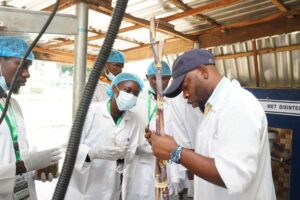
Before the cane, there is the land
The next question was not simply whether sugarcane can grow, but whether the land is being prepared in a way that allows the crop to perform.
The trainees were introduced to land development and field layout, including the timing and sequence of land preparation. The training material stresses that good preparation should begin six to eight weeks before planting, with tillage carried out when the soil is friable rather than too wet or excessively dry.
The reason is practical. Working soil when it is too wet can smear and compact it, while working it when it is too dry can produce hard clods. Poor preparation can affect not only the plant crop but also subsequent ratoons.
Harrowing, levelling, drainage and irrigation therefore become part of the same production equation. The trainees were shown how secondary tillage can break down clods, improve sett-to-soil contact, level the field and support more even planting and irrigation.
For young professionals entering the industry, these are decisions that can appear routine from a distance but have significant consequences once they are working on thousands of hectares.
Every drop of water has a production consequence
Water management formed another important part of the field training.
The trainees were introduced to the relationship between weather, crop development and irrigation demand. The training uses the crop evapotranspiration equation, ETc = ETo × Kc, to explain how atmospheric demand and crop growth stage determine the amount of water required by the crop.
The lesson becomes particularly important during the grand-growth phase, when sugarcane’s water requirement reaches its peak. The training material puts peak crop demand at about 8–9 millimetres per day during grand growth, when the crop is also highly sensitive to water stress.
The trainees therefore had to understand irrigation not merely as the application of water, but as a management decision tied to crop physiology, weather and yield.
The same principle applies to drainage. Too much water can be as damaging as too little, making irrigation and drainage two parts of the same field-management system.
This was the kind of technical judgement the programme was designed to develop.
The field became the classroom
By the time the trainees moved deeper into practical sessions, the estate itself had become the learning environment.
The programme required them to identify sugarcane growth phases, pests and diseases, understand irrigation and drainage infrastructure, operate around estate machinery, design and schedule irrigation, execute land preparation and planting, handle seed cane, apply fertiliser and crop-protection inputs, analyse soil and plant samples, and determine cane quality through measurements such as Brix, Pol and Purity.
It was a deliberately applied approach.
For Ajibola Joy, another participant, seeing the processes in operation made the lessons more memorable.
“What you see sticks better than what you were taught in the class. I am really, really elated to be part of this experience,” she said.
Her comment captures the practical logic behind taking the programme to Lafiagi.
A graduate may understand crop science in theory. But commercial agriculture requires the ability to stand in a field, examine a crop, assess its condition, take a representative sample, interpret what the numbers mean and decide what should happen next.
That is a different level of competence.
From the field to the Sugar Laboratory
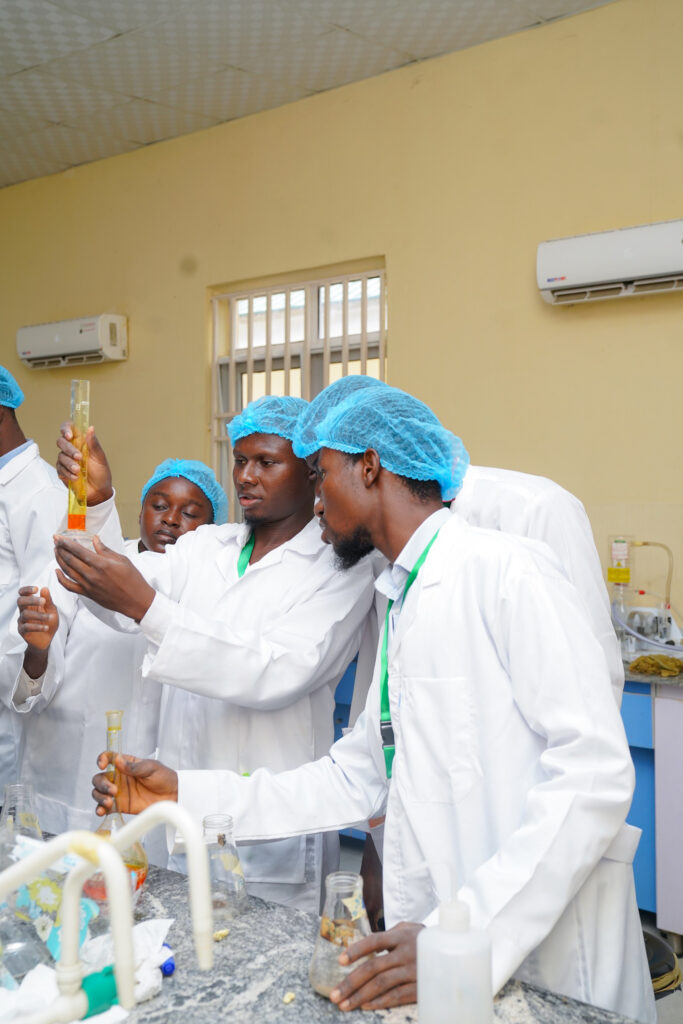
The training did not end at the estate. After completing the 12-day field phase at Lafiagi, the trainees moved to the Nigeria Sugar Institute in Ilorin for the final six days, where the programme continued in the Institute’s Sugar Laboratory.
The laboratory phase focused on soil and plant sampling techniques, laboratory equipment, soil nutrient determination and sugarcane quality analysis, including Brix, Pol and Purity. It gave the trainees an opportunity to connect observations from the field with the scientific analysis that supports production and quality decisions.
For Asou Joy, the experience provided a clearer understanding of the relationship between soil and sugarcane production.
“Now that we know all these, we will be able to know the particular soil to use for our sugarcane,” she said.
The NSI phase also broadened the trainees’ understanding of sugar production beyond field cultivation. Afolayan Faith said the experience helped her see how different parts of the production process are connected.
“Coming to the NSI, I realised that sugarcane production is actually an integrated process. It’s not limited to field cultivation,” she said.
The transition from estate to Sugar Laboratory completed an important part of the training. At Lafiagi, the trainees worked directly with the crop, soil, water, machinery and field operations. At NSI, they examined samples and applied laboratory methods that provide information for understanding soil conditions, crop performance and cane quality.
The two phases therefore complemented each other. The field provided the production context, while the laboratory provided another layer of technical evidence for understanding and managing that production environment.
A workforce strategy for a self-sufficient sugar industry
The significance of the training extends beyond the 15 graduates at LASUCO.
Nigeria’s renewed push towards sugar self-sufficiency under the Nigeria Sugar Master Plan 2.0 (NSMP 2.0) requires more than expanding hectares, attracting investment and building production infrastructure. It also requires people with the technical capacity to operate, manage and sustain those investments.
The NSI training is therefore another practical tool in that broader effort.
While NSMP 2.0 provides the strategic framework for moving the sector towards increased domestic production, programmes such as the Lafiagi intervention address a critical part of the implementation equation: the people who will work the fields, manage production systems and support the technical operations that turn investment into actual sugar production.
The connection is straightforward. More productive estates require better field decisions. Better field decisions require technical knowledge. And technical knowledge becomes more valuable when professionals can apply it under real production conditions.
The 15 trainees have now been exposed to precisely that reality, moving through field operations at Lafiagi and specialised laboratory work at the Nigeria Sugar Institute.
For NSDC and NSI, the completion of the programme represents more than another training exercise. It is part of the work of building the technical workforce required for an industry expected to produce more sugar locally, support more investment and reduce Nigeria’s dependence on imported sugar.
The 15 young professionals have completed an intensive progression from academic knowledge to field operations and Sugar Laboratory practice, gaining exposure to the technical systems that underpin commercial sugar production.
At Lafiagi and the Nigeria Sugar Institute, the training has demonstrated a simple but important point: building a self-sufficient sugar industry requires investment not only in land, infrastructure and technology, but also in the people who will operate, manage and sustain them.


Click here for pictures: https://drive.google.com/drive/folders/1GydYWtH5yANiOb_gQiam13dE6WK17a5A